Ayutthaya: 8 Temples You Absolutely Must See on Video!
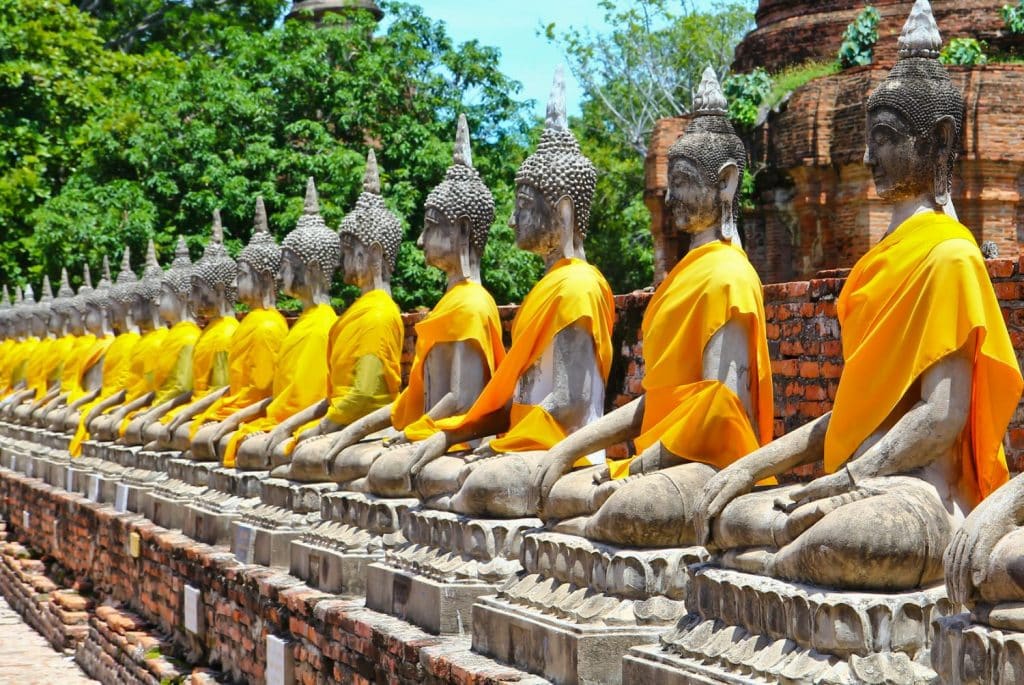
My visit to Ayutthaya (find the video at the bottom)
Exploring Ayutthaya, it was magnificent with Emy my meeting Thaie because we took the day to experience this fabulous moment. In these remains, we feel the entire past of the country on this plot of red bricks and earth of several hectares. The visits are simple, you have to pay a few baths at each temple to explore them.
We took the 8:30am train from Bangkok straight to Ayutthaya Single Station. You have to ask for the train that goes to “Benkali” the terminus. Ayutthaya is not displayed as a final destination on departure boards. I prefer to tell you, then ask at the ticket counter for a ticket to the Thai city otherwise you will spend a lot of time looking for the right platform. Then thinking about leaving early is obligatory, to visit these monuments. Remember that it normally takes 2 days to see everything, but one day is enough to admire the eight most beautiful temples.
Where do we arrive?
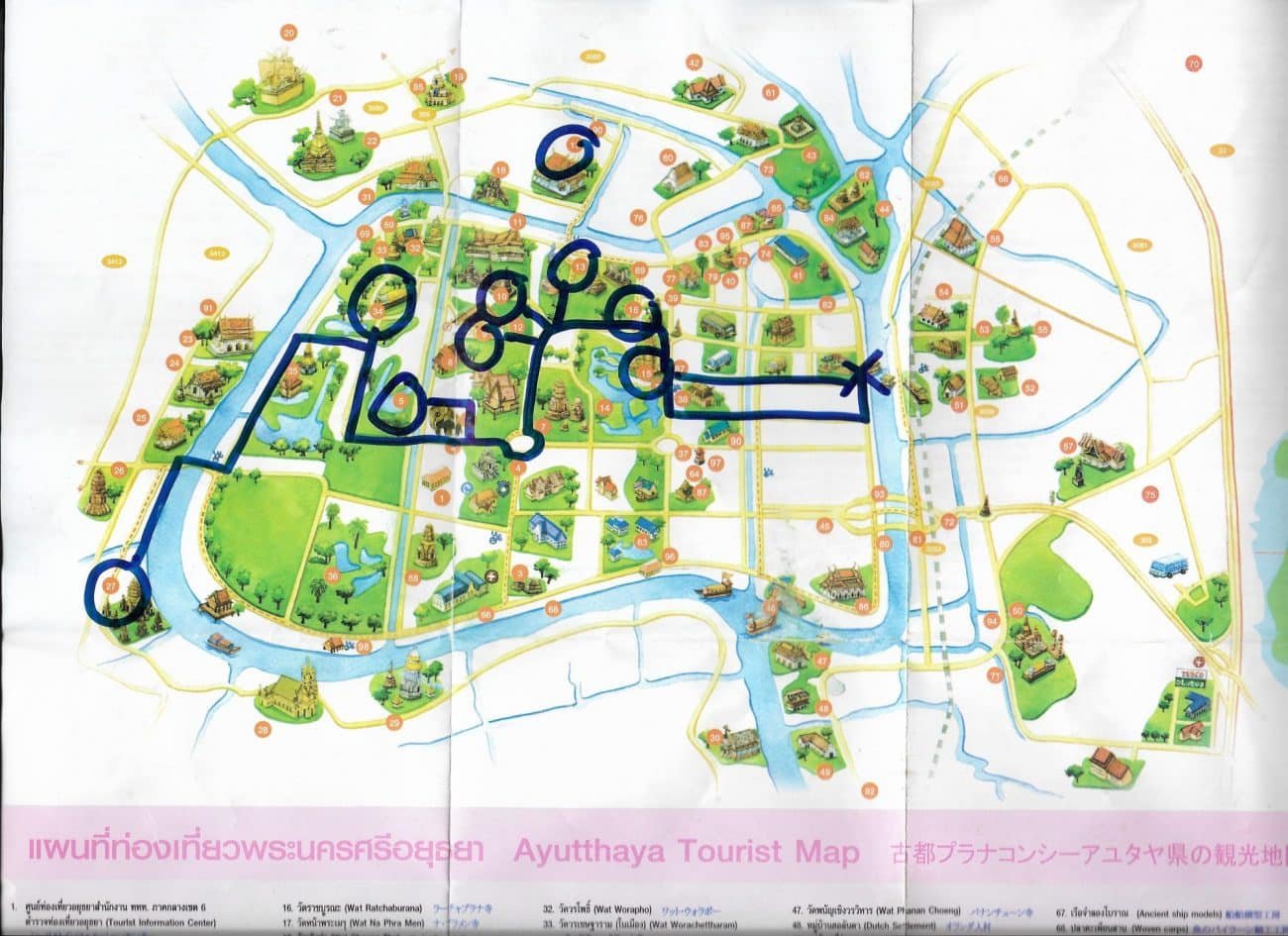
Look on the map above, you arrive via the dotted line which is the railway. Just go towards the cross to cross the river by boat and the bike tour can begin. Cycling remains the most efficient and ecological way to enjoy the city’s multiple temples.
Explore Ayutthaya, the city blessed by the gods for over 400 years
The city was founded in 1350 by King U-Thong and became the capital of his kingdom, generally known as the Kingdom of Ayutthaya. For more than four centuries, the city of Ayutthaya, former capital of the Kingdom of Siam between the 14th and 18th centuries, grew richer and larger, giving life to an extraordinary architectural landscape. But the many temples that once brought glory and splendor to Ayutthaya were mostly destroyed during the capture of the city by the Burmese in 1767. The surviving temples are now scattered throughout the modern city.
Once on the bike, we begin the visit at marker 15 indicated on the map above.
1/ Location 15 on the map: Wat phra mahathat
The Wat Phra Mahathat. Its “prang” (architectural form borrowed from the Khmers) is supported by “Garuda”. These are sacred birds whose stone effigies seem to watch over the temple for eternity. It is the best-known and most visited temple in Ayutthaya because of its famous Buddha head trapped in the roots of a tree. It is also one of the most beautiful temples in the city. At the foot of the « prang », a Buddha dressed in a traditional yellow silk cloth seems to be guarding the temple, while along the walls stands a whole row of cross-legged Buddhas, most of whom have unfortunately been decapitated, victims of theft.
The temple was built by Borommaracha I in 1374 and was completed by King Songtham (1610-1628). Wat Mahathat was thus the illustration of Mount Meru, the center of the universe where the god Indra resided but also a place where the relics of Buddha were preciously preserved. The town of Ayutthata had multiple Chedis and Prangs. That of Wat Mahathat was, however, the most important. Unfortunately, it did not stand up to the wear and tear of time and ended up collapsing.
2/ Location 16 on the map: Wat Ratchaburan
This temple was built in the 15th century by King Borommaracha II, the seventh ruler of Ayutthaya. It was built in 1424 in memory of his two brothers who died during a duel on the back of an elephant which was to determine which of the two would succeed their father, King Intharacha I. Although the victim of a fire in 1967, the restoration work allows you to admire the full splendor of the monument with its towers, its central prang and its crypt.
The crypt would be one of the most important in Thailand, it contained many royal objects. This temple has also revealed an incredible archaeological treasure. The sovereign Borommaracha II had the building built after invading and pillaging the Khmer city of Angkor Thom in Cambodia. He is said to have brought back his treasure and hidden it in the “prang” of the temple. Gold objects, tablets and Buddhas were unearthed in 1957 and are today exhibited at the Ayutthaya National Museum.
3/ Location 13 on the map: wat Thammikarat
It has several buildings from various periods, including one of which only the walls remain. Neither its brick chedi surrounded by singha, nor its emblematic enormous bronze head are the real treasures.
4 / Location 17 on the map: wat na phra men
Wat Na Phra Men was restored during the reign of Borommakot (1732-1758) and survives. It was renovated again in 1835 and 1838 during the reign of Rama III. The buildings are a mixture of different styles, Ayutthaya and Rattanakosin.
5/ Location 10 on the map: Wat phra si Samphet
Only members of the royal family were allowed to enter to pray. The temple is characterized by its three “chedis” whose gray color reflects recent restoration work. They welcomed the royal ashes. The ashes of kings Trailok, Borom Rachathirat and Rama Thibodi II as well as relics of Buddha are said to rest in these three chedis. The temple was surrounded by a pond with lotus flowers. Inside, there was a gigantic statue of Buddha commissioned by King Rama Thibodi II. 16 meters high and covered with 250 kilos of gold leaf, it was a testimony to the power of the kingdom of Siam at the time. It unfortunately did not resist the Burmese invaders in the 18th century who melted it.
6/ Location 9 on the map: wihan phra mongkhon bophit
Built at the beginning of the 20th century, it consists of a single building with simple architecture but on its pediment, the slopes of the roofs are beautifully decorated and above all it houses one of the largest Buddha when you Explore Ayutthaya.
7/ Location 5 on the map: Ayutthaya Elephant palace
If your favorite animal is the elephant like me, then stop everything and go see them. This place is that of an association for the protection and grooming of old elephants. To do and if you want to know more they have a website.
8/ Location 34 on the map: wat lokayasutharam
This is the place to see if you want to see the reclining Buddha outdoors without a roof. Numerous offerings are at its feet and along its entire length. Don’t forget to also make an offering of a few baths out of respect for the culture and beliefs. It is a replica of the reclining Buddha of Bangkok at Phat Pho without really resembling him.
9/ Location 27 on the map: Wat Chaiwattanaram
Exploring Ayutthaya and this temple requires moving away from the center of the city and crossing the river, but it is well worth the detour. The magnificent Chaiwattanaram temple is, in my opinion, the most impressive temple in Ayutthaya. It is said to have been built by King Prasat Thong (1629-1656) to commemorate the victory over the Khmers in Cambodia.
Exploring Ayutthaya, bonus: the Portuguese quarter
Exploring Ayutthaya also means seeing the Portuguese quarter. It perfectly illustrates the commercial and diplomatic relations that were established from the 17th century with Westerners. To the Portuguese quarter were added other foreign camps outside the city, to the south of Ayutthaya. It is thus possible to visit the Japanese and Dutch “villages”. Many nationalities (Dutch, Portuguese, English, French etc.) were present in Ayutthaya. With a population which reached nearly 3000 inhabitants, the Portuguese community was the largest. Most of them were merchants or soldiers.
Saint Joseph’s Church
When the French missionaries arrived in Ayutthaya, King Narai granted them territories. They built a church there, the current Saint-Joseph Dominican Church. The church was destroyed by the Burmese attack in 1767 and was rebuilt in 1831. This church contrasts with the multitude of Buddhist temples that populate Thailand. The formidable city of Ayutthaya, which reigned for 417 years until its definitive destruction by the Burmese, today offers us the magnificent vestiges of its past. Unfortunately, for some of them time is running out. When you Explore Ayutthaya, take a good look at the soil which is soft. At the foot of the monuments each rainy season it gradually tilts the temples at the risk of seeing them collapse.
Explore Ayutthaya in video below.
Thanks to Jean (green t-shirt in the video), a vlog reader who introduced me to his visit to Ayutthata on Facebook. As the principle of francejetequitte.com is also to make your contribution here, so I’ll show it to you. It reveals a few places I talk about above. The images are timeless because Ayutthaya will remain the ancient city.
And to get started, equip yourself with a recent paper guide, do like me and use one of these guides:
[amazon_link asins=’2816154645,2816162850,2013237049,2011612586′ template=’ProductCarousel’ store=’francejetequi-21′ marketplace=’FR’ link_id=’6b527557-58f4-11e7-929a-a7ff73b56c4e’]

French entrepreneur, expatriate since 2016. From radio to tech, from Bangkok to London via Hong Kong and Montreal. Founder of Komby (SaaS/AI). This blog tells the journey.