Visiting Agra
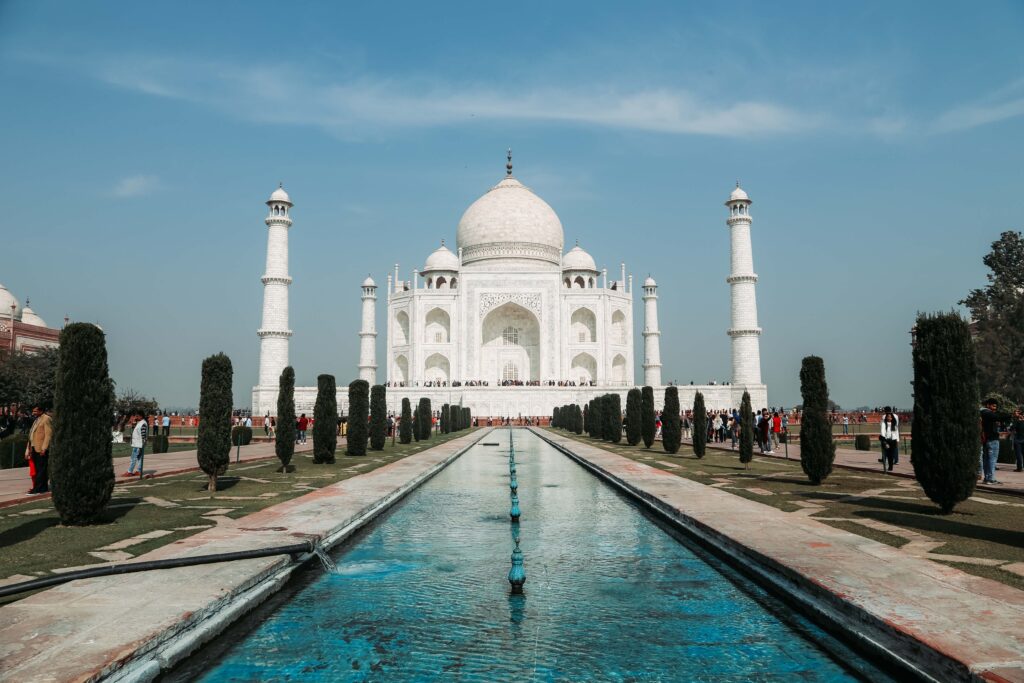
Why visit Agra in India? When I asked people in France, no one answered what I expected. When I gave a clue: “one of the 7 wonders of the world”, people said: The Taj Mahal. Well done, because the pearl of India is located about 4 hours by train from Delhi. It is not wrong to say that this city was the capital of a bygone era under the Mughal Empire. Hence the presence of multiple places to see and additional reasons to visit Agra. The city is known by travelers and lovers of the country for this. But there are other beautiful things to see in Agra. I think of my first monument when arriving from the station: Agra Fort.
Agra Fort
This fort is imposing, impossible to miss when arriving by train from Delhi or Jaipur to visit Agra. In texts we hear about it in 1080 AD but it was enlarged between 1565 and 1573 by the Mughal emperor Akbar. Covering an area of 38 hectares, it is the largest fort in India alongside that of Gwalior. It was listed as a UNESCO World Heritage Site in 1983. The surrounding walls, made of red sandstone, are 21 meters high and 2.5 km long.
During my visit, I was touched by this story told by a French-speaking guide. He explains that a short part of its history is linked to the Taj Mahal. A story that I find sad is that of a ruler’s son who locks his father in the fort’s prison after he completes the construction of the Taj Mahal. A takeover of power which was cruel at the time but common according to my guide. In short, by reading the rest, you will understand that this emperor lived a life of suffering for the power of a son and the loss of a wife. The Muslim emperor died within its walls on January 31, 1666, and was buried next to his wife at the Taj Mahal.
The Taj Mahal
It is a love story that gave birth to this wonder on the banks of the Yamuna River. Following the death of his wife, the Muslim Mughal emperor Shâh Jahân erected a mausoleum in this place in her memory. It was known as Mumtaz Mahal, which in Persian means “the light of the palace”. She died on June 17, 1631, giving birth to the emperor’s fourteenth child.
It was therefore in 1631 that the construction of the Taj began, but most of it was completed in 1648. I recovered some valuable documents to provide information on its construction. These documents explain: “How did such a masterpiece come into existence here in the middle of nothing? » Its architecture is unique, a style that combines Islamic, Iranian, Ottoman and Indian architectural elements. It is built using materials from various parts of India and the rest of Asia. More than 1000 elephants are used to transport building materials during construction.
The most beautiful things for a woman’s love
White marble is extracted from Rajasthan, jasper comes from Panjâb, turquoise and malachite from Tibet, lapis lazuli from Sri Lanka, coral from the Red Sea, carnelian from Persia and Yemen, onyx from the Deccan and Persia, garnets from the Ganges and Boundelkand, agate from Yemen and Jaisalmer, crystal from rock of the Himalayas. In all, twenty-eight types of fine or ornamental polychrome stones were used to compose the marquetry patterns inlaid in the white marble.
Do you realize this madness? Of this genius? Splendid, grandiose, incredibly moving, in short, there is no shortage of adjectives to describe this work. If there is one thing you must do before you die like this emperor, it is to see his work, the Taj Mahal.
In the store, find my EBOOK on India, and otherwise, you can buy one of these books:
[amazon_link asins=’2816152812,2816153924,2013301898,2013237014′ template=’ProductCarousel’ store=’francejetequi-21′ marketplace=’FR’ link_id=’9ebe31ca-58e1-11e7-931d-b3c81c300c02′]

French entrepreneur, expatriate since 2016. From radio to tech, from Bangkok to London via Hong Kong and Montreal. Founder of Komby (SaaS/AI). This blog tells the journey.