How I became a radio host when everyone said it was impossible

From cooking apprenticeship to NRJ: how I self-funded my broadcast studies and joined France’s #1 radio station — when nobody believed in me.

There comes a time in life when you know. Not because someone guided you. Not because a teacher tapped you on the shoulder. You know, that’s all. And it’s terrifying. Because what you know, no one else sees.

I knew I wanted to be on the radio. And everyone around me thought it was ridiculous.


The sound of pans

I was sixteen when I put on my first chef’s jacket. Apprentice. Jouy-en-Josas. Hands in the steam, feet in the rush of service, a thousand euros per month when you have the chance to touch everything. I lived with my mother. I put each ticket aside as if it were the last.

I really liked the cooking. There was something in this rhythm – the precision of the gestures, the pressure of the shot, the pride of sending a clean plate. But deep down, I knew this wouldn’t be my life. It was like wearing a suit that didn’t quite fit you. You can create an illusion. But you know.

What I didn’t tell anyone was that in the evening, when I came home, I listened to the radio. Not as a listener. Like someone who studies. I dissected the voices, the transitions, the silences. The way a host could make 500,000 people laugh in three sentences. I wanted to be on the other side of the post.


The price we pay for a dream that no one understands

Three years of apprenticeship. Three years of saving on a salary that already didn’t allow for much. And that wasn’t enough.

The school cost thirty thousand euros a year. Thirty thousand. When you earn a thousand euros a month and you live with your mother, it’s a number that doesn’t exist. It’s as if someone told you: “To live your dream, you must first swim across the ocean. »

I had to ask my father. A man with whom things were not simple. I paid him back, every penny. But having to ask — that costs more than money.

And then I had to work for a year in security. Security guard. Standing for hours, watching people pass by, mentally counting the euros that accumulate towards this impossible number. Thirty thousand.

Nobody encouraged me. No one told me “go for it, you’ll get there”. The silence of the people around you, when you announce a dream that does not correspond to their image of you — it is more violent than the mockery.


The man who made me smile

Boulogne-Billancourt. 1999. I’m sitting in an office that smells of wood and cold coffee. In front of me, Mr. Marchione. Eyes that scan you without you realizing it.

He looks through my file. Professional baccalaureate. Narrowly obtained. Background: cook. Nothing — absolutely nothing — that says “this boy belongs in front of a microphone.”

He raises his head. And he asks THE question. The one that everyone asks me, but asks him differently — without contempt, with real curiosity:

“What does someone who used to cook do in radio? »

I looked for something intelligent to say. Something constructed, mature, convincing. But what came out was just the truth:

“I am greedy for life. J’ai envie d’apprendre. »

It wasn’t brilliant. It wasn’t a motivational speech. But he smiled. And that smile opened a door for me that thousands of euros could not have opened alone.


The voices we hear every day

In this school, the walls had ears — literally. The speakers were not classic teachers from a theory book. These were the voices that the whole of France heard every morning when they woke up.

Jacky Gallois, the face and voice of Europe 1 at that time. A guy who watched you do your first broadcast and who, with one word, could make you understand in five seconds what a three-hour course couldn’t teach you.

Max, from Fun Radio. And others. Animators who took the train between two shows to come and pass on their art to around twenty kids who dreamed of being them.

For two years, I breathed radio. The writing, the rhythm, the technique. How you fit a joke to a jingle. How do you build emotion before cutting for commercials. How you talk to a million people and feel like you’re only talking to one.


Corsica, Brest, and then the whole of France

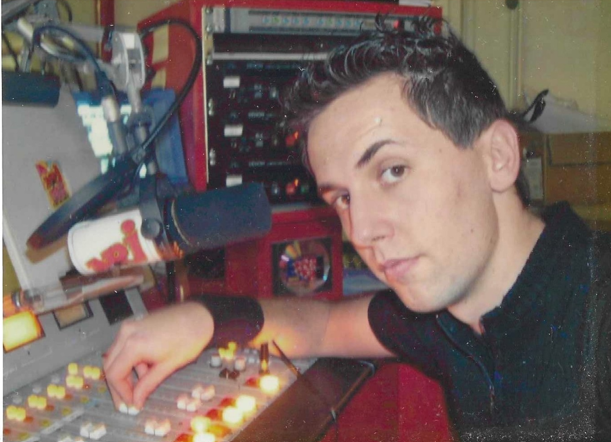
My diploma in hand, my first position falls:NRJ. In Corsica.

To understand what that meant, you have to rewind. We are in the early 2000s. NRJ has just dethroned RTL for the first time in twenty years —13.4% cumulative audience, more than6.6 million listeners every day. Radio is the king of media. There is no TikTok. No guys filming themselves eating their pasta. No “he’s living his best life” in fifteen-second vertical format. None of this exists.

Radio is the last place in France where a single voice can reach millions of people at the same time, without an algorithm, without likes, without sharing. Just your voice, the microphone, and the antenna.

After a year in Corsica, I went to Brest. And then, one summer, I was called for replacements in Paris. On the national network.

That morning, when I went on the air and knew — really knew — that my voice was coming out of every car radio, every clock radio, every kitchen in France… I thought of that office in Boulogne-Billancourt. To Marchione’s smile. A thousand euros per month. At hours standing safely. To my father.

And I said to myself, “They were all wrong. »


Behind the scenes

I metRoberto Ciruelo, the program director.Frédérique Pau. People whose names listeners don’t know, but who decide what six million people will hear tomorrow.

And then there were the artists. The ones you meet in the studio corridors. Those who show up for an interview, surrounded by their team, but who in front of the microphone become just human beings telling a story.

David Guetta— before the stadiums, before “Titanium”, before the million-a-night fees. At that time, he was already a big name on the French electro scene. But no one yet imagines that he will become the most famous DJ on the planet.

Bob Sinclar— “Love Generation”, “World, Hold On”. Number 1 titles around the world in 2005. A French Touch guy who proves that France can export something other than wine and fashion. When he releases a song, the world dances to it.

Scorpios— Klaus Meine in interview. “Wind of Change” but it’s not from NRJ because it’s not in the format. One hundred million albums. A group that wrote the anthem of a world that was changing, while the Berlin Wall was falling.

I was there. The kid from the professional baccalaureate. The former cook. Sitting across from these people, with a microphone between us.


What others have made of my success

When my old friends understood that it was true – that the cook was really on the radio, that his voice was really on NRJ – something broke.

I don’t know if it was jealousy, incomprehension, or just the discomfort of seeing someone come out of the box in which they had put them. But they moved away. Those I considered my friends stopped responding.

And others appeared. People I hadn’t seen in years. Strangers who suddenly wanted to become “super close”. As if being on air made me someone different.

I didn’t dig into these new relationships. They smacked of calculation, not friendship.

It’s a lesson you don’t learn in any school: success doesn’t bring you friends. It shows you which ones were true.


What radio really gave me

It’s not a job that I did. It’s a school of life disguised as a job.

The radio taught memarketing— not that of the textbooks, that of the field. How you create an image. How you build a brand that people recognize in a second. How NRJ dethroned a twenty-year-old giant by understanding better than anyone what 13-25 year olds wanted to hear.

She taught medirect communication— you have three seconds before the listener changes stations. Three seconds to capture, move, make people laugh. No second take.

She taught me thecommunities— create bonds with people you never see, who you will never touch, but who trust you because you are in their daily life every morning.

She also taught me the web. 1st responsibility on the web.

Everything I do today — this blog, Komby, the music — comes from there. From those years on the other side of the job, learning that a sincere voice is worth more than all the marketing budgets in the world.


And now

I was told it was impossible. I paid with my body, with my time, with my pride. I worked jobs I hated to fund a dream no one shared. And I got there.

This pattern never stopped. The music label, expatriation, Digital CHR, Komby. At every step, the same music: “You won’t make it. » Every step of the way, I do it anyway.

The difference is that today I no longer seek approval from anyone. And that is perhaps true freedom.


Next article: The beginnings of Believe seen from the inside — when I met Denis Ladegaillerie in 2005, before anyone knew who he was.

The early days of Believe seen from the inside

In 2005, I met Denis Ladegaillerie, founder of Believe, before anyone knew who he was. How this encounter changed my vision of the music industry.

There are encounters that are unlike anything at the time. No spark, no violins, no “I feel like this guy is going to change the world.” Just two people in a room, a conversation, and a seed that is planted without us realizing it.

My meeting with Denis Ladegaillerie in 2005 was exactly that.


A former Vivendi lawyer in his living room

To understand who Denis Ladegaillerie is, you have to rewind. Born in 1969 in Limoges, son of an oil industry executive, he grew up in Normandy. Law in Rouen, management at ESCP, a master’s degree at Duke University in North Carolina, then a career as a business lawyer in New York.

At the end of the 90s, he watched his roommates – guys well established in finance – leave everything in six months for unknown startups. Intrigued, he joined Vivendi in 2000, where Jean-Marie Messier bought everything related to digital. At Vivendi Net, he dissects “hundreds of Internet deals”. Then he was sent to Los Angeles, to MP3.com – the ancestor of SoundCloud – which Vivendi had just bought.

When the bubble burst and Fourtou scuttled digital assets at the end of 2004, Denis was 32 years old, with a sharp eye, and “the most expensive master’s degree in the world” in his pocket – in his own words. A kitesurfing accident repatriates him to France. A helping hand from destiny.

In 2005, he created Believe. In his living room. In Paris. With Arnaud Chiaramonti, former marketing boss of Sony Music France, and Nicolas Laclias.


Scooters, hard drives, and 30 euros

Believe in its beginnings, it’s not an office in a tower. It’s interns, scooters to deliver Fnac and Virgin, CDs that we digitize on the assembly line, and hard drives that we send by FedEx to American distributors.

Their first operation? A compilation for Virgin Megastore during the Fête de la Musique. Benefit:30 euros. “We were extremely proud,” Ladegaillerie would later recount.

This guy, with his provincial notary air and his strict suit, was quietly building what would become the fourth major music company in the world. But in 2005, to the outside world, he was just a converted lawyer wasting his time in a Parisian salon.


The triple bet that no one understood

What struck me when I met Denis was the clarity of his thesis. While everyone around was screaming about the death of music — major labels taking kids to court for downloading three songs on LimeWire — he anticipated three things:

  • The disappearance of the CD— inevitable, a matter of time
  • Lower production costs— which would open the door to millions of independent artists
  • The emergence of a new economic balance— streaming would end up paying off

A triple bet “very daring at the time”, as Sandrine Dufour, former boss of Vivendi Net, would later say. “The first digital model was piracy. We only paid for the phone ringtones. »

Denis didn’t care. He saw further.


The room where I met him

At that time, I came from radio. I spent years interviewing artists, looking at the music industry through the window of the NRJ studio. But one desire is working within me: to create. Produce. Releasing my own music. The idea of ​​a label germinated somewhere in the back of my mind.

And now I find myself in front of a guy who has built exactly the bridge I need to take my music across to the rest of the world. Not Universal. Not Sony. An independent. With a global infrastructure.

What struck me was not the charisma — Denis is not one of those people who takes up all the space in a room. It’s calm. Conviction without noise. While the others were panicking, he was laying bricks.


What happened next

The Parisian salon has become a multinational:

  • 2009: Believe is profitable. Four years, less than €2M in cumulative losses. Launch of Zimbalam, a self-production platform that detects talents
  • 2012: Apple lists them in 53 countries for iTunes. In six months, the international dimension explodes
  • 2015: Acquisition of TuneCore – the platform that brought Ed Sheeran to life
  • 2016: Purchase of Naïve — Carla Bruni, Benjamin Biolay in the catalog
  • 2017: Sony offers 400 million euros. Denis refuses
  • 2020: 700 million turnover, 2,000 employees, contracts with more than 1 million artists, present in 45 countries. Winner of the Future Unicorns Trophy
  • 2021: IPO on Euronext Paris.Valuation: 1.9 billion euros
  • 2024: Repurchase by the EQT consortium for withdrawal from the stock market

A guy in his living room with 30 euros of first turnover. Nineteen years later: 1.9 billion.


What I took away from this meeting

I didn’t sign a contract that day. I didn’t launch my label right out of the room. But something has changed in my way of seeing.

If a former lawyer could create a global distribution network for freelancers from scratch from his couch—shipping hard drives by FedEx and delivering Virgin by scooter—then what was stopping me from doing the same thing on my own?

The answer: nothing. Except fear.

Three years later, in 2008, I foundedElectromix Records. And it is via Believe that my titles will be distributed in240 territoriesacross the world. The bridge that Denis had built, I crossed it.


The pattern

Looking back, this meeting is part of a pattern that defines my life:

Being in the room with the people who are going to change the rules of the game — before the world knows it.

David Guetta before the stadiums of 80,000 people. Denis Ladegaillerie before 1.9 billion. An expatriation blog before TikTok invented “digital nomads”. A digital agency for businesses before AI makes humans optional.

Pascal Nègre, the former boss of Universal France, said of Denis: “He is a visionary. He realized very early on that a purely digital model could very quickly work in music. »

I was in the room when all this was still just a conviction whispered in a Parisian living room. With Komby, this time I will not be a spectator of the transformation. I will be the one who wears it.


Next article: Why I started Electromix Records — from radio to label, how a former chef distributes his music in 240 countries.

Why I created Electromix Records

From radio to music label: how I founded Electromix Records in 2008 and distributed 13 singles across 240 territories via Believe, without any major label support.

There comes a time in the life of a radio host when you realize that the microphone doesn’t belong to you. The voice is yours, but the station belongs to someone else. The playlist is decided by someone else. The audience you build every morning, piece by piece, joke by joke — it belongs to the brand, not you.

In 2008, after almost ten years of radio — NRJ, Fun Radio, MFM — I understood that I wanted to create something that would truly be mine. Not carrying the voice of others. Wear mine.


The call of production

Electronic music, I was immersed in it since my NRJ years. The interviews with Bob Sinclar, the parties, the playlists that I built for my shows. But there was always this frustration: I was selecting other people’s music. I staged it. I introduced her. But I didn’t create it.

Meeting Denis Ladegaillerie three years earlier had shown me that the wall between “creating music” and “putting it into the ears of the whole world” no longer existed. No need for Universal anymore. No more begging an art director for twenty minutes. A good title, a digital distributor, and the world opens.

So I jumped.


The first sounds

Electromix Records was born in 2008 with a simple objective: to release quality house music and electro, and distribute it around the world via Believe.

My first single —Ibiza Hype— comes out under my own name. It’s a strange moment. Go to the other side. No longer be the one who presents the music, but the one who makes it. When I heard my song for the first time in a set, in a club, with people dancing to it without knowing that the former radio host was in the room… it was a feeling difficult to describe. A mixture of pride and unreality.

Then things happen.Give Love, remixed byMuttonheads— a duo recognized in the European house scene. When producers of this caliber agree to touch your track, it’s a validation you can’t buy.


The catalog

Over the years, Electromix Records has grown:

Yane Solöne— Facing the Sea, Playa d’en Bossa, Stomp, Open Your Mind, Quebras Esta DJ. An artist project that taught me how to manage the development of a career from A to Z.

Oliver Kaan & Diana Joselle—Right Beside You.2 Fabiola—Straight to the Top.Platinum Girls—Ignite My Fantasy.Chris Feelding—Love on Track.Jim Marlaud & Al Swan—Love You Like That.

And the compilationClubbin’trax 2.0— 24 titles brought together to show the DNA of the label.

In total:13 singles, 1 compilation. Distributed on Spotify, Beatport, Apple Music, Deezer, YouTube Music, Amazon, Tidal. In240+ territories. From Japan to Brazil, from Scandinavia to Australia.

The former chef from Jouy-en-Josas had his music heard all over the world.


What running a label teaches you about entrepreneurship

A label is a business disguised as passion. Each single is a product launch. Each artist is a partnership to be built and managed. Each release has a strategy, a timing, a positioning.

You learn marketing — not the kind of PowerPoint slides, the kind that makes someone click “play” instead of scrolling. You learn management — contracts, royalties, splits. You learn patience — a title can take six months to find its audience.

And most importantly, you learn that creating something of your own, even if it’s small, even if it doesn’t make you a millionaire — it’s worth infinitely more than building someone else’s audience.


The break

In 2013, personal life took over. Marriage, children, then divorce. A period where you no longer create — you survive. The label has fallen asleep. Not dead, but in hibernation.

The titles remained online. Royalties continue to fall, modestly. The catalog still exists, intact, somewhere in the Believe servers which powers platforms around the world.

Thirteen years of silence.


2026 — The awakening

Today, Electromix Records comes back to life under the bannerKomby Music. New titles —Komby Komby, Komby Make It Easy— mark the beginning of a new era.

It’s not nostalgia. It’s the culmination of a whole journey. Radio gave me the voice and the marketing. The label gave me production and distribution. Expatriation gave me freedom and perspective. Digital CHR gave me the land and the technology.

And Komby puts it all together in one machine.

Since 2008, I have learned how to create, distribute, market and scale a creative product on a global scale. The only thing missing was the right vehicle to carry everything at once.

This vehicle now exists. And this time, he won’t fall asleep.


Next article: How the retail crisis transformed Digital CHR — and why the agency model is doomed.

How the business crisis transformed Digital CHR

From the agency model at 379€/month to the Komby SaaS at 79€/month: why I transformed Digital CHR and why the agency model is doomed to disappear.

There are businesses you create because you spotted an opportunity. And there are those you create because you can’t stand watching a problem that nobody solves.

Digital CHR is the second kind.

2016 — The sector is booming. I see something else.

When I launch the Digital CHR activity in 2016, the hospitality sector is thriving. Everywhere.

France: 442 million tourist overnight stays — a record. The restaurant industry generates €58 billion in revenue, up +5.4% year-on-year. Les Échos headlines read « another bumper year for French hospitality. »

United Kingdom: 46,850 pubs open, the sector holds strong. Chains are expanding, investors are confident.

United States: record hotel occupancy at 65.5%. RevPAR (revenue per available room) up +3.2%. Global tourism crosses 1.4 billion international arrivals.

Everyone is optimistic. No one is preparing for what’s coming.

But me, on the ground, I already see the problem: restaurant owners and small businesses are drowning in digital. Not because the market is struggling — because the tools are fragmented, expensive, incomprehensible. The sector grows, but the small players are already underwater.

2019 — The company is born. The agency takes shape.

I set France Je Te Quitte aside. The blog had done its job — a pioneer in expatriation content, before TikTok, before « digital nomads » in swimsuits on Instagram. But in 2019, Digital CHR becomes a real company. Another urgency is calling.

The restaurants, hotels, bars, and shops around me are struggling with digital like a beginner swimmer thrown into the middle of the ocean. They have:

  • A booking tool (they barely understand)
  • Another for social media (they neglect)
  • Another for Google reviews (they dread)
  • Another for their website (they forget)
  • Another for CRM (they don’t have)

Everything is scattered. Everything is expensive. And nobody offers them something simple. Not « simple to sell. » Simple to use.

I create Digital CHR to be that solution. My team and I do by hand what technology doesn’t yet automate: community management, websites, customer reviews, digital marketing. Bespoke. Human.

The golden trap of the agency model

On paper, the model is beautiful:

A client pays €379/month. One community manager handles 15 clients. 15 × 379 = €5,685 revenue per CM. The CM costs €2,500–3,000 loaded. Margins exist. All good.

Except real life isn’t a spreadsheet.

The CM says 15 clients is too many. That they can’t cope. That we need to hire. The clients complain. The work isn’t reactive enough, not creative enough, not « them » enough.

And me? When I managed those 15 clients myself, effortlessly, they were thrilled. The feedback was excellent. The difference was that it was me. My energy, my involvement, my eye for detail.

But I can’t clone myself.

The result: revenue that pays people who do worse than me, for clients who end up disappointed anyway. The agency is a hamster on a wheel. You run, you sweat, you make noise — and you end up in exactly the same place.

COVID as a truth accelerator

Then the world stops. Government-mandated closures. Empty terraces. Takeaway-only restaurants. Ghost hotels.

A crisis doesn’t create problems — it reveals them. And what it reveals in my sector is something far deeper than a pandemic:

Fragmentation kills small businesses.

Not competition. Not lack of customers. Fragmentation. Too many tools. Too many subscriptions. Too many providers. Too many things to understand, configure, maintain. The restaurant owner who just wants to cook good food ends up managing eight different dashboards.

And the agency — my agency — is part of the problem. We’re one more tool in the stack. One more provider on the list. One more cost on the balance sheet.

The invasion of the opportunists

And as if that wasn’t enough, COVID created a massive gold rush.

The media — in France, the UK, the US — hammered for months that restaurants needed « help with their digital transition. » Delivery, click-and-collect, social media, online visibility. Every newscast, every front page. The message was clear: there’s a market to grab.

And the opportunists poured in. By the hundreds.

Self-employed freelancers who appeared out of nowhere. Young people who saw « a problem to scale. » People who couldn’t find jobs and launched solo to « manage restaurants’ social media. » Not out of conviction. Not out of expertise. Out of timing.

They charged €200/month for what we charged €379 — except they had no infrastructure, no experience, no perspective. They trashed what we did. « Too expensive. » « Not agile. » « Old school. »

We had been on the ground for five years. Five years understanding restaurant owners’ real needs. Five years breaking our teeth on actual problems. We weren’t there because of a COVID opportunity. We were there because we had seen the need before everyone else.

But try explaining that to a prospect when some kid across the table offers the same thing at half price by posting three Instagram stories a week. The market was flooded with low-cost providers who dragged prices down — and standards with them.

That’s the second reason the agency model is dead. Not just because it’s inefficient — because it became impossible to defend against free and almost-free competition.

2025–2026 — The sector collapses. The numbers are brutal.

Here’s what the hospitality sector looks like today, compared to its glowing health in 2016:

France: 9,465 insolvencies in accommodation and food services over 12 months (March 2026) — that’s +28.4% in one year. The Banque de France cites « deteriorating economic conditions » and « weakened financial positions since the end of COVID. »

United Kingdom: 3,353 hospitality businesses insolvent in 2025. Another 762 in Q1 2026. Liquidations are 45% above pre-COVID levels. British pubs: from 60,800 in 2000 to 45,000 in 2024. Brewdog closes 38 out of 49 bars. Revolution Bars collapses.

United States: 9% of full-service restaurants classified as at-risk of closure in 2026. Insolvencies up +4% across all sectors.

The problem isn’t COVID. COVID ended long ago. The problem is structural: costs are rising (energy, labour, raw materials), customers spend less, and digital tools remain fragmented and expensive. Exactly what I saw in 2016 on the ground. Except now it’s killing businesses by the thousands.

The moment of clarity

One evening — I can’t remember exactly when, but it’s the kind of moment that stays with you — I asked myself a simple question:

Why am I asking a business to pay €379/month for a human to manually do what software could do for €79/month?

Not « in theory. » Not « in five years. » Now.

The technology exists. AI exists. No-code tools exist. The only reason the agency model survives is inertia. People are used to paying someone else to do things for them. But when you show them they can do it themselves, faster, for a quarter of the price — the choice is obvious.

That’s where Komby is born. In that space between « the problem I’ve been solving for six years » and « the technology that finally allows solving it at scale. »

The transition — what it looks like in practice

Today, former Digital CHR clients are migrating to Komby:

  • Before: €379/month — a human doing a mediocre job
  • Now: €79/month — the Komby platform, 3 apps included, total autonomy

For those who still want a human safety net: +€150/month for assistance, no commitment.

The client saves money. They pay €229 instead of €379 with assistance. Or €79 if they want pure autonomy.

And me? I earn more per client in net margin, without payroll, without dependence on employees who do worse than me. The SaaS is locked in for 12 or 24 months. Predictable revenue. Clean margins. Real scalability.

« The agency model will never disappear »

An anecdote. The daughter of one of my clients runs a web agency. Website creation only. She tells me, looking me straight in the eye: « It’s impossible we’ll disappear. People will always want human relationships. »

I looked at her without saying a word. But here’s what I was thinking:

People have never clicked so much and called so little. They order dinner without speaking to anyone. They book a hotel at 3am in their pyjamas. They leave a Google review while waiting for the tube. They don’t want « a human relationship. » They want autonomy. Speed. Control.

What agencies call « human relationships » is middleman work. It’s time billed on tasks the client could do themselves in five minutes with the right tool.

People who deny this reality aren’t brave. They’re scared. And I understand — I ran an agency myself. But fear doesn’t change the direction of the wind. It just makes you arrive late.

Why this time is different

With radio, I was building someone else’s audience.

With Electromix, I had my catalogue — but the model remained artisanal, dependent on my personal energy.

With Digital CHR, I had my clients — but I was selling human time that didn’t scale, trapped in the hours/revenue ratio.

With Komby:

  • It’s my product — every line of code, every feature
  • It’s scalable — 1 client or 10,000, same infrastructure
  • It’s recurring — monthly subscriptions, not one-off projects
  • It’s locked in — 12-24 month commitments
  • It’s impossible for an employee to copy — a CM can leave with clients, they can’t leave with the software

Six years on the ground. Six years understanding the real problems of real business owners. Not an MBA idea read in a book. A solution forged in the daily pain of customer service.

And this time — for the first time — I’m the one who keeps the lead.

This is the journal of an entrepreneur who has lived several lives. Radio, the record label, expatriation, the agency, SaaS. Each stage built the next. None was an accident.