There comes a time in life when you know. Not because someone guided you. Not because a teacher tapped you on the shoulder. You know, that’s all. And it’s terrifying. Because what you know, no one else sees.
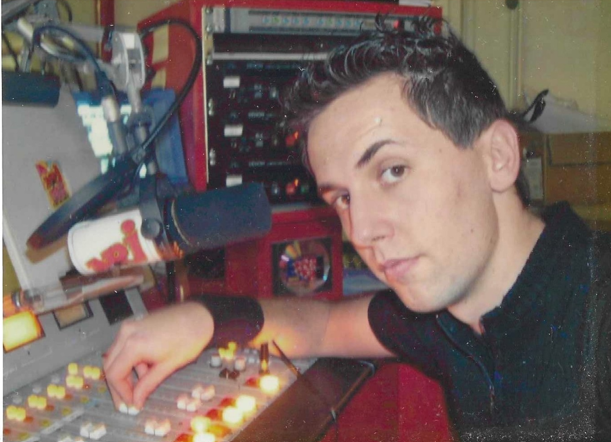
I knew I wanted to be on the radio. And everyone around me thought it was ridiculous.
The sound of pans
I was sixteen when I put on my first chef’s jacket. Apprentice. Jouy-en-Josas. Hands in the steam, feet in the rush of service, a thousand euros per month when you have the chance to touch everything. I lived with my mother. I put each ticket aside as if it were the last.
I really liked the cooking. There was something in this rhythm – the precision of the gestures, the pressure of the shot, the pride of sending a clean plate. But deep down, I knew this wouldn’t be my life. It was like wearing a suit that didn’t quite fit you. You can create an illusion. But you know.
What I didn’t tell anyone was that in the evening, when I came home, I listened to the radio. Not as a listener. Like someone who studies. I dissected the voices, the transitions, the silences. The way a host could make 500,000 people laugh in three sentences. I wanted to be on the other side of the post.
The price we pay for a dream that no one understands
Three years of apprenticeship. Three years of saving on a salary that already didn’t allow for much. And that wasn’t enough.
The school cost thirty thousand euros a year. Thirty thousand. When you earn a thousand euros a month and you live with your mother, it’s a number that doesn’t exist. It’s as if someone told you: “To live your dream, you must first swim across the ocean. »
I had to ask my father. A man with whom things were not simple. I paid him back, every penny. But having to ask — that costs more than money.
And then I had to work for a year in security. Security guard. Standing for hours, watching people pass by, mentally counting the euros that accumulate towards this impossible number. Thirty thousand.
Nobody encouraged me. No one told me “go for it, you’ll get there”. The silence of the people around you, when you announce a dream that does not correspond to their image of you — it is more violent than the mockery.
The man who made me smile
Boulogne-Billancourt. 1999. I’m sitting in an office that smells of wood and cold coffee. In front of me, Mr. Marchione. Eyes that scan you without you realizing it.
He looks through my file. Professional baccalaureate. Narrowly obtained. Background: cook. Nothing — absolutely nothing — that says “this boy belongs in front of a microphone.”
He raises his head. And he asks THE question. The one that everyone asks me, but asks him differently — without contempt, with real curiosity:
“What does someone who used to cook do in radio? »
I looked for something intelligent to say. Something constructed, mature, convincing. But what came out was just the truth:
“I am greedy for life. J’ai envie d’apprendre. »
It wasn’t brilliant. It wasn’t a motivational speech. But he smiled. And that smile opened a door for me that thousands of euros could not have opened alone.
The voices we hear every day
In this school, the walls had ears — literally. The speakers were not classic teachers from a theory book. These were the voices that the whole of France heard every morning when they woke up.
Jacky Gallois, the face and voice of Europe 1 at that time. A guy who watched you do your first broadcast and who, with one word, could make you understand in five seconds what a three-hour course couldn’t teach you.
Max, from Fun Radio. And others. Animators who took the train between two shows to come and pass on their art to around twenty kids who dreamed of being them.
For two years, I breathed radio. The writing, the rhythm, the technique. How you fit a joke to a jingle. How do you build emotion before cutting for commercials. How you talk to a million people and feel like you’re only talking to one.
Corsica, Brest, and then the whole of France
My diploma in hand, my first position falls:NRJ. In Corsica.
To understand what that meant, you have to rewind. We are in the early 2000s. NRJ has just dethroned RTL for the first time in twenty years —13.4% cumulative audience, more than6.6 million listeners every day. Radio is the king of media. There is no TikTok. No guys filming themselves eating their pasta. No “he’s living his best life” in fifteen-second vertical format. None of this exists.
Radio is the last place in France where a single voice can reach millions of people at the same time, without an algorithm, without likes, without sharing. Just your voice, the microphone, and the antenna.
After a year in Corsica, I went to Brest. And then, one summer, I was called for replacements in Paris. On the national network.
That morning, when I went on the air and knew — really knew — that my voice was coming out of every car radio, every clock radio, every kitchen in France… I thought of that office in Boulogne-Billancourt. To Marchione’s smile. A thousand euros per month. At hours standing safely. To my father.
And I said to myself, “They were all wrong. »
Behind the scenes
I metRoberto Ciruelo, the program director.Frédérique Pau. People whose names listeners don’t know, but who decide what six million people will hear tomorrow.
And then there were the artists. The ones you meet in the studio corridors. Those who show up for an interview, surrounded by their team, but who in front of the microphone become just human beings telling a story.
David Guetta— before the stadiums, before “Titanium”, before the million-a-night fees. At that time, he was already a big name on the French electro scene. But no one yet imagines that he will become the most famous DJ on the planet.
Bob Sinclar— “Love Generation”, “World, Hold On”. Number 1 titles around the world in 2005. A French Touch guy who proves that France can export something other than wine and fashion. When he releases a song, the world dances to it.
Scorpios— Klaus Meine in interview. “Wind of Change” but it’s not from NRJ because it’s not in the format. One hundred million albums. A group that wrote the anthem of a world that was changing, while the Berlin Wall was falling.
I was there. The kid from the professional baccalaureate. The former cook. Sitting across from these people, with a microphone between us.
What others have made of my success
When my old friends understood that it was true – that the cook was really on the radio, that his voice was really on NRJ – something broke.
I don’t know if it was jealousy, incomprehension, or just the discomfort of seeing someone come out of the box in which they had put them. But they moved away. Those I considered my friends stopped responding.
And others appeared. People I hadn’t seen in years. Strangers who suddenly wanted to become “super close”. As if being on air made me someone different.
I didn’t dig into these new relationships. They smacked of calculation, not friendship.
It’s a lesson you don’t learn in any school: success doesn’t bring you friends. It shows you which ones were true.
What radio really gave me
It’s not a job that I did. It’s a school of life disguised as a job.
The radio taught memarketing— not that of the textbooks, that of the field. How you create an image. How you build a brand that people recognize in a second. How NRJ dethroned a twenty-year-old giant by understanding better than anyone what 13-25 year olds wanted to hear.
She taught medirect communication— you have three seconds before the listener changes stations. Three seconds to capture, move, make people laugh. No second take.
She taught me thecommunities— create bonds with people you never see, who you will never touch, but who trust you because you are in their daily life every morning.
She also taught me the web. 1st responsibility on the web.
Everything I do today — this blog, Komby, the music — comes from there. From those years on the other side of the job, learning that a sincere voice is worth more than all the marketing budgets in the world.
And now
I was told it was impossible. I paid with my body, with my time, with my pride. I worked jobs I hated to fund a dream no one shared. And I got there.
This pattern never stopped. The music label, expatriation, Digital CHR, Komby. At every step, the same music: “You won’t make it. » Every step of the way, I do it anyway.
The difference is that today I no longer seek approval from anyone. And that is perhaps true freedom.
Next article: The beginnings of Believe seen from the inside — when I met Denis Ladegaillerie in 2005, before anyone knew who he was.
The rest of the journey — building Komby in 14 steps — and the product at komby.io.